Author: Eric Millman

  • Pigneto, L’acquedotto Felice

    Pigneto, L’acquedotto Felice

    By some measured cliches, Rome is the ragged symbol of culture both high and low, the hot-blooded beating heart of the world.  The city of Keats’ bloodied last breath, of Fellini’s swollen pseudo-libido, of Berlusconi’s (several) bunga-bunga parties.   Rome may well be a city of layers and conflicts, a million-dollar convertible rumbling over thousand-year-old cobblestones, a plate of minced lamb hearts and a gang of bedazzled grandmas, but I’ll be damned if I understand it at all.  Yet here I am once again, stepping out from a train and into proof that perpetual motion is, indeed, attainable.

    Roma Termini is one of many postwar travertine travesties in Italy.  Boxy, squat, and streaked with sixty years of grime, it was perhaps once a marvel of modernism, a sleek set of ribs jutting out from a geometric beast suspended overhead, but now it just overwhelms one’s spirit.  I’m of the mind that an Italian train station should be explicitly bland and utilitarian for all the dizzying complexity contained within: the shouting, the sweeping crowds, the machine gun-toting police, the crowd’s surging indifference and the looming probability of getting mugged.  Maybe I’m overvaluing architecture.

    As soon as I exit the station, I’m already lost.  Rome is a tangled terracotta web of seemingly identical vie and strade, only bigger, socked with old people who bemusedly watch you pretend like you don’t need help.  An hour’s walk puts me back at the station, whose grinning, mouth-like entry is surely designed to mock tourists like me who are too stubborn to concede that they are tourists, or too proud to take the fucking metro.

    It’s my third time here: first, on a drunken college field trip, of which I recall little; second, with my family, when I was bitten by a carriage horse outside of the Vatican.  This time, I’ve come in search of something real, to blacken my heart and dirty my ears with some proper live music from the subcutaneous layer of this metropolis where, beyond a few notable neighborhoods, few foreigners venture.

    A quick search on the Internet’s Insider® outlets circa 2016 names Pigneto as the place to be for wistful hepcats such as I, a sort of Roman Oakland, a grungy, alternative place where you could really hear some music.  I’ll note that Pigneto was once, to no one’s surprise, one of the poorest areas in the city, a hodgepodge of dumpy architecture and bad business beloved by Italy’s intellectual hero, Pier Paolo Pasolini.  Pasolini famously called the neighborhood “the crown of thorns that encircles the city of God.”

    Pasolini was slaughtered on the Roman coast for his temerity; I missed my fantasy baseball draft for this vacation — not quite on the same level — and I probably owed it to his memory not to waste it on my own poltroonery.

    ||

    Poltroon or not, after accident-ing on the Colosseum for the third time, I pony up the €1.50 on a metro ticket, and disembark at Furio Camillo.  With Pigneto booked up or out of my price range, I settle for a room here along the medieval Via Tuscolana, just outside of the ancient Aurelian walls in one of the more genuine parts of town, a skip south of my destination.

    By the time I arrive, all allure for the city has dissipated.  I slink past empty bars and neon family restaurants, impressed by none, feet aching, dreaming of a fiery pit into which I might hurl my backpack.  Rosario, my host, greets me with a furrowed brow.  I’m three hours late.  He’s boiling a pot of proper Italian pasta: tomato puree, made from his family’s garden, to be draped over some actual capellini, and generously plates me an amount I subsequently destroy with my mouth.  I apologize in profuse, profane Italian for my tardiness, my hunger, and my smell, and he half-smiles, offering his beastly guest a napkin and a spare towel.

    Rosario is a thirtysomething lawyer from Naples, his flat a pinnacle of brutalist architecture. Its sweeping, anonymous angles and bright pastels frame a balcony overlooking a million others hovering over the mess of honking below, and I gobble up its generous anonymity with more zeal than I had shown the pasta.

    My host shrugs, and pulls on a pair of Nikes in preparation for a birthday out in the suburbs.  He rattles off a few nightclubs in Trastevere, the so-called “American” district.  I note, brandishing my Insider® Italian, that I was actually hoping to get deep into the alternative scene in Rome, to check out the sort of venues typically off-limits to foreigners.  “I want to find music, you know?  Like, not some touristy place, but somewhere you’d go.”

    He’s confused.  “Trastevere.  I just told you.”

    He clearly wasn’t understanding what I was after.  “I’m looking for something autentico, like, senza turisti.  Hey, what about…Pigneto?”

    “It’s Tuesday.  There is nothing in Pigneto on a Tuesday.  It will be boring and sad.  I promise you, I really think you would be happy to go to Trastevere.”

    ||

    My first stop in Pigneto is Lo Yeti, a bookstore I’d read about on the Internet.  Bohemian, artsy, with music every night.  Just the place for a student of culture like myself.  I roll up to the bar with a knowing smile and order a glass of Cannellino di Frascati, one of the only true Roman varietals.  The owner, wiping down a cup, looks outside at the still-setting sun and counters with a Montefiascone.  “Ah, Montefiascone,” I say, not knowing what that is.  “Ottimo.”  Don’t I want something to eat with it?  She looks at me as if I had just suffered a long, slow tumble, pants at my ankles, on national TV.  I reassure her it’s just an aperitivo, thinking I’d take dinner later in the evening, like a proper Roman, because Romans eat late.  She gives me a cup of crackers anyway and looks at me with inestimable pity.

    The bookshop is cozy and refreshingly devoid of books.  In English, anyway.  I browse with my glass of Montewhatever, perusing the pages with knowing nods, chin perched in hand, comprehending almost nothing.  Seated underneath a small arch in the kid’s corner is an insubordinately fashionable female person, probably a few years younger than myself and equally alone: just the type of clientele the Internet implied I would find in this Pigneto.  I smile and wave and she responds in kind, but at the woman behind me, freshly arrived.  Now in a chair far too small for me, I eavesdrop on the language lesson, waiting for a moment to interject despite the certain fact I don’t speak a word of Japanese.

    The heavily-perfumed, angora-wearing woman next to me notices, desperate to save me from further shame, and asks where I’m from.  I scoff, playfully, “what makes you think I’m not from here?”  She forces a smile, and awaits my response.  “Sono americano,” I respond, and we’re both a little disappointed.  We sit in silence, her burly partner completely disinterested in contributing to the conversation, most assuredly displeased by the situation altogether.  Mercifully, a procession barges into the shop, ten young punks in torn black Levi’s interrupting the nothing with frothy screams I do not understand.  “Fascisti?” I ask my friend over the din.

    She looks at me with a familiar pity.  “Antifascisti,” she says, and returns to her partner.

    By now, a tattooed and pierced string quartet is setting up on the café side, bringing in with them a following of smiling grey-haired intellectuals with rimless glasses hanging off the edge of their wrinkled noses.  Trastevere my ass!  This is what I came for!  They would probably launch into an interpretative-but-still-recognizable suite of Nino Rota compositions to which I’d nod along knowingly, and the Japanese student would wait impatiently until intermission at which point she’d nervously tap me on the shoulder and ask but how do you know all of those songs and I would shrug, modestly noting, I dunno, I guess I’m just that devoted to Italian cinema, and we would totally exchange social media profiles.

    As the band tunes up, I notice a shriveled, lamentable young man in a wheelchair sitting behind me all alone, staring, perhaps, at my flowing blonde Californian hair, my authentically bohemian clothes, or my functioning legs.  I want to soothe him with small talk, asking come stai? Tutto bene?  Hai visto la partita?, to reassure him that things were going to be just fine in this cruel, anonymous world of ours.

    “You are blocking my view of the band,” he says in perfect English.

    Shuffling apologetically, bowed at the waist, I circle the bar once and find no empty seats, including the one I’d just vacated, and without the demoralizing wink of acknowledgement from any of my new friends, I slip out the front door undetected.

    The sun is now quite set and I figure it’s about time for a real aperitivo at a place that’s a bit looser, a bit more me.  I make a right at the main drag, Via del Pigneto, and find a trove of dark, shoddy-hip bars and restaurants calling my name.  Only one, Libreria Tuba, has a line out the door, and I head there first.  The bartender is probably 6’2”, with blonde dreads reaching down her inked back.  I’ve a good feeling about this place.  I opt for a Negroni, the quintessentially bitter Florentine cocktail, and the bartender winks.  She knows I’m in the know.

    I take a seat at the back of the bar in a tiny alcove conveniently located next to the bathroom.  The chairs are as pink as my drink, and a pair of college-aged girls, cute in a fetid sort of way, giggle at me.  I smile back, tipping my drink their way, feeling accepted, if not entirely welcome.  Their eyes crane upwards, directed toward a giant black dildo hovering over my head.  A vibrator on the bookshelf.  A cornucopia of toys behind glass.  Soon, a few other women notice me, and they cheers their beers in my direction.  In the cinematic version of this scene, a fully nude human would have then clapped me on the back, garbling the punchline well he aaaasked for “alternative” as I, spilling my drink on my crotch, scampered out the door.  In the real life version, however, I play it cool, finishing my drink with calm, and thank the young ladies for no apparent reason, ambling confidently back into the street.  And then ambling back into the bar because I forgot to pay, but then back out.

    In Italy, and especially in Pigneto, a walk around the corner can be like walking through a sephia portal and coming out in an alternate universe.  A warm glow spills out from such a portal down the street. It’s il Tiaso, a place full of leather-bound books and wine bottles framing a stately charcoal sketch of the great Fred Fellini himself.  That there’s hardly enough room for the haggard vagrant just inside the entrance, let alone a band, let alone me, is of no concern when I am in the company of Maestro Federico.  The smell of moldered cotton pages, the sound of the creaky floor flaked in generations of paint, the muted glimmer of the chipped chalkboard menu all feel like a warm embrace, and I pony up to my third bar, by now not at all sober.  The bartender, whose arms easily span the length of the so-called enolibreria, smiles warmly, welcoming me with a regal bow.  He walks me through the menu with pride, his messy, salt-pepper mop bouncing with every nod.  I entertain another Montewhatever, and can tell immediately that he is pleasantly surprised by the breadth of my knowledge. And that I’ve chosen the most expensive glass on the menu.

    A woman enters and his posture shifts as if by poisoned barb.  I rattle on, oblivious, and finally take a Sardinian bovale to the seat just beneath the Maestro.  There’s a soccer match on the sunbleached TV and in competition with the impressive library next to me, it’s the victor of my attention, because I’m both erudite and an American who watches soccer sometimes.

    The woman at the bar grows heated.  The bartender is not smiling.  They shout in Roman-ese, or at least in a version of Italian I do not understand, or at least in some language that isn’t English.  She throws her glass at him and it smashes against the wall.  In their culture, be it Roman or otherwise, this presumably indicates frustration or disdain, because yeah, he’s just slapped her in the face.  The haggard doorman steps in, copping a feel as he pulls her away.  Her arms jut out, grasping for hair to tear.  The bartender is accordingly full of rage, spitting venom, seeking flesh to chunk.  I hereby decide that I no longer like him, and abandon the remainder of my bovale on the table under my beloved Fellini’s disapproving gaze, and leave without paying.  I expect him to chase after me, to tear my limbs from my body, but that has not yet happened.

    ||

    The sun having mysteriously disappeared below the earth, I am now engulfed by the darkness of Via del Pigneto, meandering entirely drunk and completely alone, feeling my way through the mealy humidity.

    It really is getting late, and I decide that if I want to see music, I’ll have to make dinner a quick one.  I pop into Viveri, a spot at the mouth of the road just slender enough for one person to pass.  The bartender, severe in his pomade and his camicia nera, has a quick wit to him, all business, the type who spins the glass in his hand as he waits for your order, who never smiles and would call you “boss” were the restaurant in the United States.  His colleague has her hair bleached powder-white, her ironic smile masked in fluorescent lipstick. The menu is but a wall with three types of polpette scrawled in chalk.  I’m in the dinner capital of the earth and I’ve chosen a wine-and-meatball house.

    If there was ever someone who can’t abort a half-plan it’s me, having already ordered a fat cannonau, and I deign to treat this aperitivo as dinner.  By now the hollow of my stomach is pumping the booze directly to my brain, and I force myself to focus on my original task.  I pump the neon bartendress for clues, name-dropping some real Insider® Italian band names.  “The real stuff, you know?”

    She looks to her friends clumped at the end of the bar and I pretend not to see them roll their eyes.  Handing me a weekly musical imprint, she rattles off a few venues in the area, each one shot down by her friends.  I’ve finished my meatballs and a second cannonau, and the woman  throws up her hands.  “It’s Tuesday,” she says.  “Maybe you should try Trastevere?”

    ||

    By eleven the streets are positively deserted. If it’s not time to go home, it’s time for much worse. Now soused, I saunter up and over the train tracks, and everything turns a cinematic sephia in my head.  Nonne beat their rugs on balconies above, eyeing me suspiciously; drifters deal cards under the crumbling arches of the acquedotto Felice; my bladder heaves with wine pleading for evacuation.  Far ahead on an unlit street, a lone server shakes out a tablecloth outside the Ristorante Accattone, so-named for the Pasolini film (itself yet another way of saying “vagabond”) which, it seems, he shot on this very road nearly sixty years prior.  I offer to buy one last amaro if the server lets me use his toilet, and miraculously, he agrees.

    Relieving myself in the back of that dark restaurant, I crane my ear to a subtle wafting over the din of my urine against the porcelain.  It’s music.  From the kitchen.  Why was it so familiar?

    My mama don’t like you and she likes everyone
    And I never like to admit that I was wrong
    And I’ve been so caught up in my job, didn’t see what’s going on
    But now I know, I’m better sleeping on my own
    ‘Cause if you like the way you look that much
    Oh baby, you should go and love yourself
    And if you think that I’m still holdin’ on to somethin’
    You should go and love yourself

    I zip up, cheers the server, and set back on my way down the via del Mandrione, relieved of all concern.  All according to plan.

  • Homage to o’ Musso

    Homage to o’ Musso

    Glow of gum
    And sea of spittle
    neon captain calls, vien’cca!
    Feral and grave
    Lemon of pink
    Salting hornwise, loose and every which way

    Thieve my money, o shouty man
    O laughy man, just take my tenner
    Thy house of mirrors
    of cheerful cartilagenry
    Like lissome loaves of salty soap
    Gushing acid on rancid tongue

    Smuscolato
    Smaschiato
    Smascherato
    Miscuglio della mucca
    Muschiata
    E mezza morta
    Come me.


  • A History of the Bistecca alla Fiorentina: the best beef this side of sizzler

    A History of the Bistecca alla Fiorentina: the best beef this side of sizzler

    In the threadbare aftermath of World War II, the Florentine Jewish publisher Corrado Tedeschi, alongside Other Human Man Ugo Cavallini, founded the Partito Nettista Italiano.  This was an ideologically-oriented political organization which promised “450 grams of bistecca [alla fiorentina] guaranteed daily to all people,” at a time when Italians were struggling to fill their bellies with anything at all.  Such is a mocking promise aimed to impale that of the Fronte dell’Uomo Qualunque (Alliance of the Everyman) who promised they would provide “a chicken on every plate.” The Americans amongst us may recognize this as a post-pot reference to the delusional Depression-era political slogan associated with Herbert Hoover, but get this: it’s originally attributed to France’s Henry IV.  Suck it, slogans!  Though deliberately derivative, Tedeschi’s rallying cry went to truly absurd heights, marking what has been called the first satirical Italian party and perhaps the very origin of “anti-politics” in the modern age: a chicken, be it plated or potted, was one thing.  A bistecca per person, per day, was another entirely.

    As a moderately impoverished person, I find this funny.  Of the truly iconic, highly desireable Florentine dishes — ribollita (vegetable “minestrone” repurposed as a sort of stew with stale bread), lampredotto (the boiled fourth stomach, or “rennet-bag,” of the cow), or crostini made with fegatini (effectively an extremely fatty chopped liver) — the royal bistecca doesn’t seem to fit.  For a cuisine definitively, proudly, humble, the bistecca is very much not that.  It’s an odd contradiction, extremely Florentine without even being Italian: though the meat itself originates from a strain of flesh stripped from the Tuscan/Umbrian/Lazian Chianina cow — the beefiest, hulkiest in the world — the name bistecca is doubtlessly derived from the language in which this essay is written, namely English.  Historians such as Pellegrino Artusi and Jeff Wikipedia trace the name and culinary convention to the British Knights, who so enjoyed the roasted cows consumed in Florence for the Feast of San Lorenzo on August 10th that they would then clamor for da BEEFSTEAK whenever they would return to town.  Then, of course, this might all be utterly false.

    The Beef was always a symbol for me, a ritual.  I’d save up my money and quit my job and spend a month or two in Italy living like a piece of shit, a welcome change from California, where I was also living like a piece of shit.  I’d come to Florence and drop mega-florin on a kilo of bistecca, a bottle and a half of chianti, and, to grace the bowels, a side salad.  I would eat the cow flesh as raw as my post-meal posterior would get from overwiping, and I would masticate and swallow until my facial capillaries were popping with cow’s blood. A week spent on bread and wine, a night like an Edwardian king, and then death.  It is the best steak in the world.  It is worth it.

    In the year of 2019 I had but one of The Beef.  With friends visiting, we convened at a steakhaus called Trattoria dall’Oste, a place known as much for their bus banners as for having launched a plate of their PR Beef into space  At this meal, there was me and there were two of the aforementioned friends, one of whom was a vegetarian.  I showed up serious coupons, and was countered with an asking price of seventy euro.  For a beefslice.

    Not only was it stringy and overcooked and foul of taste, relying on ramekins of sauce, but it gave me diarrhea.  It gave me explosive, devastating diarrhea for 24 hours.  Dear reader, it was bad, this diarrhea: my o-ring was twitchy and bloodied and I couldn’t sleep one bit.  Were there a button that could eliminated this local chain of “chianinerie” in a type of explosion that caused no human injuries and reassigned all employees jobs they enjoyed, which is to say any other job at all, I would press it twice.

    Perseus: the last meal before the 2020 Lockdown.  Our academic institution had compelled us to our home countries, and most were heeding this demand; I was not, and together we had one last lunch by which we could destroy ourselves the old fashioned way.  There at Perseus they give you jugs of plush wine, and you pay as you drink, which is a good idea.  There at Perseus, the server is perhaps the owner, and he is scary and sarcastic and very proud of the menu.  Rightfully so.  I order rigatoni with lampredotto, perhaps, on the side, and the man dumps a heavy platter at the center of the table.  The steak is butterflied against the grain, with the bone jutting out as if it had been used to kill itself on the way from the kitchen.

    This is buttered sashimi.  They don’t use sauce, they don’t need sauce, they don’t want sauce, just a T-Bone, thick as a foot, cured briefly in salt and served with fat-ass pepper berries cracked and wading in grease like a fat Roman in a hot spring.  The Beef is not springy like normal meat might be, gushing instead like a porn star at first bite, a warm, oleaginous watermelon.  The fat smells like the grass the cow had been eating.  The fat is crisped and melts like marrow and slips silently into the guts.  You dig your fingernail into the ass-crack of the bone and fish out the most tender guppy of flesh along the vertical grain and then you eat it with your mouth.  There is not a quantity of this food that would be enough; you would keep eating it like a dog, like a Jewish dog eating a cow’s carcass lacking the trigger of temperance.

    This was my last meal and after that it was just pandemic.

    As an illegal expatriate amidst a lockdown, you don’t have much of anything but the subsidized housing hosting your head, let alone a regional speciality to stuff in it.  A middle-class, moving haggis, you fill yourself with oats and cabbage and bloat in the sun.  You take your daily walk, pointless and brisk and heaving humid under COVID cover, a daily walk tweaked by the same interval in the interest of passing time and staying sane.  You are not sane..

    A new path takes you up a hill behind your subsidized home.  You have not had a bistecca in a year, and yet you remain alive.  By kismet, you pass the home of Corrado Tedeschi.  This man has been rotting in the ground for fifty years, and so you do not knock.  You think of his promise to Beef his compatriots out of their desperation by way of Beef, a dish dipped in irony.

    You wonder, am I so desperateWould I ever indulge in this ruddy turfish once again, or had we entered a new era where the promise of such, at least for the unspectacular among us, was wholly humorous?

    You wrap your hands around the wrought iron gate and stare flatly into the eyes of a goat belonging to the Tedeschi estate.  He has nothing to offer you, and you have but the same for him.

    The Memory of the Beef was burning a tiny jewel into the lining of your stomach and this, the end of the known universe, offered no hope of hamburger, let alone beacon of bistecca.  You have no choice but to walk back home, shaving a bit of white winter truffle into your bitter black mouth, fungus within fungus.

    The world would continue.  You would be born again a vegetarian, and from your wobbling podium, you would wryly promise to all a porcino in every pot.  No one having heeded your cry, you vomit, and you turn gainfully into the furniture.


  • La Bella Lingua

    A brief introduction to the delicious life of Pietro Aretino.

    And so.  If you happened to be born in Arezzo in the 1400s (or ever), and had the misfortunate sting of poetry running in your veins, your light was shadowed by Francesco Petrarca, the priest who had discovered and spread the work of Cicero, the priest whose poetry was priestly (I think?  What the hell do I know about Petrarch, really!?).

    Pietro Aretino, born the son of a cobbler named Luca del Buta who abandoned his family to become a mercenary, was a man whose name served to obscure his oirigins. Pietro Aretino was a man whose sexual appetite was such that the boys he pursued were known as “Aretini”, the girls “Aretine”; Pietro Aretino was a poet immortalized by Ludovico Ariosto as the “flagellatore de’ principi (tormentor of princes).” Yes, please.

    And so.  The story goes that when Giulio Romano, the student of Raphael, felt he was being underpaid by Pope Clement VII in his commission of the Sala di Constantino in the Vatican, he instead drew sixteen different sexytime positions on the walls (though it’s more likely that he was simply doing a sexy commission for the Duke of Mantova). Upon seeing the original work, the engraver Marcantonio Raimondi took it upon himself to immortalize the drawings before they could be scrubbed; Aretino, a friend of Raimondi, did the same in verse as part of I Modi [The Ways, otherwise known as The Sixteen Pleasures].

    “Come view this you who like to fuck,” offers Aretini in 1527 (from a 1798 reprint by A. Carracci).

    As a serious scholar of linguistics, I wish to provide a public service in translating the second of what are known as the Sonetti lussuriosi, or “Lustful Sonnets” (the most famous part of this infamous body of work).

    Mettimi un dito in cul, caro vecchione [Put a finger in my ass, dear old soul],
    e spinge il cazzo dentro a poco a poco
    [and push that dick inside, bit by bit];
    alza ben questa gamba a far buon gioco
    [raise well this leg to improve our nice little schtick],
    poi mena senza far reputazione
    [then pound away, don’t wait to be extolled].

    Che, per mia fé! quest’è il miglior boccone [But, my word!  This here is a better mouthful]
    che mangiar il pan unto appresso al foco
    [than when sitting by the fire, eating greasy chips];
    e s’in potta ti spiace, muta luoco
    [So drop your dick in the rear if don’t like the slit],
    ch’uomo non è chi non è buggiarone
    [a man ain’t a man if he don’t put it in the asshole].

    In potta io v’el farò per questa fiata [With my cunt I will do you this time, sans complaint]
    in cul quest’altra, e in potta e in culo il cazzo
    [in the ass another, and then in both goes the prick]
    mi farà lieto, e voi farà beata
    [this will make me happy, and will make you a saint]

    E chi vuol essere gran maestro è pazzo [And whoever aspires to greatness is a lunatic]
    ch’è proprio un uccel perde giornata
    [a dick who does so is just another blank taint]
    chi d’altro che di fotter ha sollazzo
    [because he who is fucking is getting their kicks].

    E crepi in un palazzo [And if you get smoked in your house or some savage shit],
    ser cortigiano, e spetti ch’il tal muoya
    [I’m telling you, my bro, if you die, that’s your deal]:
    ch’io per me spero sol trarmi la foia
    [I only need myself to make myself squeal].

    ~

    Ahem. Naturally, Aretino was nearly murdered for this, forcing him to flee Rome for Venice, that den of sin, the Land Against The Pope, where he made a fortune off of blackmailing famous people.  Meanwhile, Pope Clement VII did his best to ensure that all copies of the book were destroyed.

    A Venetian woodcut of the second sonnet, dating to ca. 1537-1550.

    He failed. In 1928, lord bless the heavens, the son of Arturo Toscanini found a copy, ensuring that this article you’re reading now could exist!

    ~

    Aretino himself would note in his Letters, “Mi dicono ch’io sia figlio di cortigiana; ciò non mi torna male; ma tuttavia ho l’anima di un re. Io vivo libero, mi diverto, e perciò posso chiamarmi felice [They tell me that I’m the son of a whore; that doesn’t bother me; nevertheless I have the soul of a king.  I live free, I entertain myself, and for that I can call myself happy].” Bless him.

    Reportedly (and by this I mean I can only find this on Wikipedia, but it’s too great a detail to ignore), Aretino died as he lived: watching a monkey walk around in boots. Having witnessed this marvelous event on October 21, 1556, the great poet was possessed by a fit of laughter so severe that itled to a mortal stroke.  And so!

    On his gravestone, attributed to the Bishop Paolo Giovio, reads the following verse:

    Qui giace l’Aretin, poeta tosco [Here lies Aretin, Tuscan poet]:
    Di tutti disse mal fuorché di Cristo [who of everyone he spoke poorly, other than Christ],
    Scusandosi col dir: non lo conosco [For which he excuses himself, saying: who?].


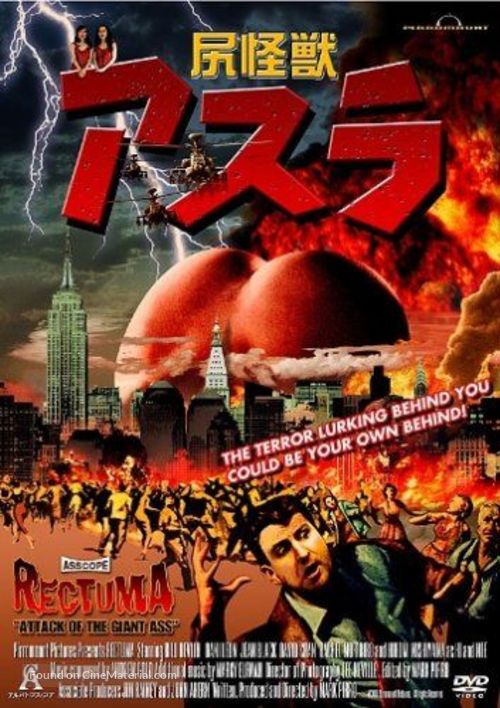
  • In Review: rectuma, a film for the ageless

    In Review: rectuma, a film for the ageless

    Imagine you are a bland, doughy mail clerk named Waldo (Bill Devlin), unburdened by dreams or desires or interests. You may well be. Imagine are on vacation with your wife, Valveeta, a philandering sociopath who wants you dead.  Unbeknownst to either of you, a Mexican butt-humping bullfrog has penetrated you physically and without your consent, leaving you with an inexplicable pain in your rear end.

    Back home your proctologist, an overzealous, pointy-eared connaisseur du postérieur, recognizes this immediately as reptilian rape, but when it comes to cures, he throws his hands up.  There’s simply nothing western medicine can do for you, he’s sorry to say.  Unless…

    Unless what?  I’ll do anything, you cry!

    Well, he says, there is one solution.  A Japanese scientist (“very authentic: accent, slanty eyes, little penis,” drawls the doctor) can provide you with an experimental, radioactive rod-based procedure to quell your problems. Only — oops! — he’s just broken off his rod in your rectum, and your ass has turned a glowing green.

    It seems your bottom (now looking more like a hairy rum babà than anything) has broken off from its top, and is killing those who have wronged you.  Unaffiliated fat people, too.

    Your ass has grown to colossal proportions and is now attacking the city.  Your ass must be stopped.

    Eat It: Rectuma
    Detective Cosacca getting his just desserts.

    It took three evenings for me to watch the full ninety-five minutes of Mark Pirro’s Rectuma (2003), a film which aspires to the no-budget heights of Troma Entertainment, but with 100% less surf nazis dying.  While I can conclude from this viewing that Rectuma (pronounced “Reck-uh-tooma”) is most certainly a film, it did leave me with a few questions.

    Why Them?  Often in films of this particular strain, tragedy befalls the most virtuous loser in a world of unvirtuous winners, forcing our hero to face his fears and whip the world back into a more suitable state.  No doubt, the exasperated, cuckolded Waldo hardly deserved to be violated by the flippant frog.  Still, I found myself wondering: why his butt?  More, why his butt?  While the good Detective Cipolla (Italian for “onion”, amongst the most sulphuric of foods) must face down her own fear of the bare derriere in order to crack this case, does she really?  Perhaps a result of my own formulaic and chauvinistic inclinations, I found myself wanting for a Waldo-Cipolla union to rationalize her very presence in the film; her gobsmacking Clarice Starling impersonation was the only sense I could make of it.  In sum:  more butt backstory, more bottom b-plot, or both, would’ve gone a long way in activating poor Waldo.

    Why music?  All due respect to the composer Andrew Gold (not that Andrew Gold, is it?!), but I would’ve liked further elaboration on the lone, haunting melody that repeats, ad infinitum, from start to end.  Please, give us more of that floating chorus, that bone-chilling duet droning self-reflexive lyrics in anticipation of the audience’s bewilderment, superimposed into urinals and onto rocks like the supercilious sirens they are…but perhaps spring for an extra melody along the way?  I would counter, however, that preferable to this plinky earworm driving us toward certain madness might be liberating us of the convention of a soundtrack altogether. Moreover, ignoring the recurring, onscreen debate over the value of subtitles, why not dispense with sound altogether?  Other than the fart noises.  The fart noises stay.

    Urinal Cakes: Rectuma
    Singing in the bathtub.

    Why not Jews?  For all the, um, subtle, playful jabs at feminists (the severe, sexless reporter “Gloria Sternvirgin”), Muslims (the gibberish-speaking terrorist “Summa Cum Laden”), African-Americans (the large-phallused adulterer “Johnny Peck”), Asians (“Dr. Wansamsake”), and homosexuals (“Detective Cocksucker”), as a Jewish-American I must admit I felt left out.  When Summa Cum Laden, straddling a rocket housed within Waldo’s giant rear, declares, “smells like home!” I could only dream of the type of punchline awaiting my people.  Perhaps in the forthcoming sequel about Waldo’s radioactive nuts, my people shall be liberated.

    Why now?  Certainly with today’s popularity of ‘90s pastiche, from the Adult Swim universe to dad fashion to the reboot of Walker, Texas Ranger, one is tempted to declare Rectuma ahead of its time.  Apart from its metamodern glitch aesthetics, shot perhaps on an Omnimovie VHS, apart from Cipolla’s constant references to Jodie Foster’s career-making turn in Silence of the Lambs (Demme, 1991), we are treated to punchlines that scream 1995, not 2003.  Regarding the size of Waldo’s mutant ass: “Are we talking Oprah large or Sally Struthers large?”  Regarding the revelation that, with the city under attack, Waldo indeed has no ass: “neither does Courtney Cox.”  To watch Rectuma is to be transported back to a time well in advance of its year of release, forcing one to ask: why now?  Why am I watching this right now?

    All of this is not to say that I am questioning Mark Pirro’s filmic intuition or mettle.  Certainly, with a career spanning four decades (from 1978’s burger-slasher short, Buns, to the forthcoming zombie vengeance feature, The Dead Don’t Desist!), the folks and Pirromount must be doing something right.  Rather, at a time when we must consider ourselves lucky to have our own asses still intact, Rectuma compels one to oneself toward self-examination, top to bottom, for the ultimate question of all: in the case of the dismembered ass, where does all the shit come from?  Thanks to the unsinkable Mark Pirro, we have both question and answer.

    Summa Cum Laden: Rectuma
    Summa Cum Laden

    Rectuma, 2003.

    Written, produced, and directed by Mark Pirro.

    Pirromount Pictures.


  • Hocus Porcus

    Eric Millman

    A confused, pseudo-sexual investigation into prosciutto, the Cadillac of dead animals.

    You pig eaters should be ashamed of yourselves.  Consuming these beautiful, intelligent beings is the ultimate act of indulgence, of cruelty, an act that borders on the profane, the cannibalistic, on the transcendently delicious and sustainable.

    To eat a pig is to sin in the eyes of the God, according a quarter of the world’s population (myself included).  I couldn’t possibly explain to you why this is, but neither can Marvin Harris, despite the lengths he goes to investigate this in his fascinating essay, “The Abominable Pig”. Nevertheless, a rule is a rule, and traditions are the foundation of a society.

    More, to dress a pig carcass with one’s bare hands, to massage salt into its skin, is as if to caress the cheek of a newly shaved, recently slaughtered lover.  If the fondling of a fresh, uncut chiccarón verges on the homicidal, it’s no wonder: the pig is our dear, intimate friend, and has been long before we could afford to equate it with shame at all.

    Myths and contradictions abound with regard to the domestic history of this unspeakably sexy beast.  Giulio Cesare Croce’s La vera historia della piacevolissima festa della porchetta (The True Story of the Extremely Delightful Feast of the Roast Pork) details a celebration on St. Bartholomew’s Day in 1584 in Bologna (a city famously nicknamed “La grassa”, or “The Fat”) wherein all citizens — even the most destitute — would gather in Piazza Maggiore to evade their persistent hunger for one to and enjoy a bit of porchetta amongst the upper classes.

    In truth, the pig is the humblest of animals, neither the exotic game that was a symbol of power at the banquet tables of the aristocracy during the High Middle Ages, nor the more delicate fowl that the noble chivalry opted for in subsequent years to leave their warlike ways behind them.  Capable of consuming almost anything, and living nearly anywhere, the pig furnishes us with the most democratic of meats.

    Pork is also relatively sustainable: it converts 35% of energy from its feed into muscle and fat, compared to only 6.5% in the case of cattle, and the concept of “going whole hog” (or better, “totus porcus” in Dog — as opposed to Pig — Latin) exists because pig’s blood, pig’s feet, and trotters are not only delicious, but considered delicious throughout the world and across classes.

    Nevertheless, this article is not about sustainability, and it’s not about recalibrating socioeconomic disparities.  Instead, we here claim the leg of this poor animal not with the purehearted charity of Fra Ginepro, who only procured the meat at the dying request of a beggar in the Little Flowers of St. Francis.  Indeed, neither San Francesco nor my Rabbi would be so pleased by my consumption of this meat, particularly on this, the evening of the Shabbat.  Rather, this is about sharing our findings to you, the reader, after having tasted some of the most expensive, least sustainable, least healthy, most commercially available meat products on earth, and doing so in the most 2021-appropriate way possible: via videoconference.

    ~

    Tonight, from Florence to Berlin, six poor little piggies donate their leg shavings, senza consenso, to three friends in the interest of your pseudo-education.  What are these meats, you ask?  Well, some of the greats:

    1. A generic culatello (the so-called “Quintessence” of the prosciutto, to cite Bernardo Bertolucci);
    2. a Schwarzwälder Schinken IGP (a raw, smoked Black Forest ham);
    3. a prosciutto from the Chianti region (automatically Fede’s favorite as it is Tuscan, and so is he);
    4. Prosciutto di Parma, and
    5. Prosciutto San Daniele (each amongst the first 158 items so culturally valuable to Europe as to be declared DOP, or Protected Designation of Origin, on the first day that measure was established);
    6. another Prosciutto San Daniele, from a different producer and exported to Germany;

    This experiment is greeted immediately by failure.  Having done my share of Googling, I’m determined to accompany my hams with unsalted, whole grain bread and a Lambrusco, one of the few noteworthy wines to come from Parma.  Fede chastises me via text message as I’m in the checkout line:  “Lambrusco is cheap trash for grandpas and students.  A chianti would be better, along with a nice, salty schiacciata to balance out the sweetness of the Prosciutto di Parma.”  What a motherfucking Tuscan.

    Abandoning my place in line, I settle instead for a volcanic prosecco and a Tuscan vin novello in the interest of defying his instructions.  And the schiacciata, but only because I like it and not because he told me to get some, you hear me?

    ~

    Some crucial notes before we begin.  Firstly, all of the meats here are salumi, from the Latin salumen, effectively meaning “salted things.”  One salame (or several salami) can be considered both an example of salume (or salumi), but also of insaccati, which are types of salumi cured in sacs, often the intestine of the same pathetic beast.  Mortadella, for example, the most grassa of grasse things from La grassa, is an insaccato.  Prosciutto, typically, is not, except for Exhibit #1, the culatello.

    Yes, culo means ass.  Yes, –ello is can be either diminutive (a small fountain, or fontana, is a fontanella, for example) or attenuative (instead of directly calling someone poor, povero, you might soften the blow by calling them poverino or poverello).  Either way, it’s a dirty, vulgar word, this culatello, and that’s appropriate enough, given that it is, in essence, an ass stuffed in an asshole.  Nevertheless, though made from pigs reared in the Parma region (a proper culatello comes from the, uh, hamlet of Zibello), it’s a cured world apart from the others even in process, given that it is deboned, and is cured with not only sea salt, but also garlic, pepper, and white wine: unthinkable additives to a traditional prosciutto.

    Culatelli from Strategia del ragno (Bertolucci, 1970)

    Our culatello, though more than twice the cost of the other options listed here, is decidedly not the prized Culatello di Zibello.  Pre-sliced and overexposed to the elements, it comes with salt crystals collected on the surface; the meat, from the leanest part of the leg, is dry and sinewy.  It is so salty that if eaten with the schiacciata I might go into anaphylactic shock, and I’m inclined to throw the rest of the prosciutto in the trash, so disappointed by this so-called “king.”  It not only goes with the prosecco, it requires it, and serves as a reminder that with all things, it’s not so much the make but the maker.

    The Schwarzwälder Schinken PGI (a step below Italy’s DOP, but still a regional specialty protected by the EU) is what is to be expected for a meat cured in potpourri of spices like juniper, coriander and pepper, and then pinewood-smoked.  Fede notes that it tastes like a forest fire and absolutely nothing else.  Why do they mask the flavor of a perfectly good pig like this?  Presumably Southern Germany has shitty pigs, or insecure farmers, or both.

    The Chianti is the cheapest horse in our race, and I’m afraid to admit to my Tuscan friend that it’s succulent as shit and the sweetest of all, almost bubble gum-fruity, suited perfectly for the goddamned schiacciata.  Truthfully, we foreigners may mock Italians for being so regional with their food, but then you find things like this that just fit together like two puzzle pieces.  My only complaint is that the ham, tender as she is, is impossible to peel apart in whole strips.

    As for the issue of make vs. maker, the Prosciutto di Parma, the most famous of all our samples and certainly the oldest, is sold under one brand name but sourced from around 150 different farms within a few miles of the city (by comparison, San Daniele boasts only 28).  For this reason, the characteristics of the stuff can vary slightly depending on both the supplier and the cut: mine, freshly sliced into small polygons from a recently tapped leg at the market, is blood-red, relatively lean, and a bit too salty; the pre-cut German export is pale, oblong, bland and greasy.  In neither case do we get a whiff of anything but flesh: they’re delicious, no doubt, but straightforward.

    The San Daniele is by far the best of this group.  That’s all, there’s just no question.  Despite being pre-sliced, commercial as can be, and right in the middle in terms of cost (cheaper than the Prosciutto di Parma and culatello, and twice the cost of the Chianti and the Schinken).  Truthfully, it is the only one of these options to boast the complexity and richness in flavor that one finds in a world-beating Jamón ibérico or a knife-cut leg from a small, traditional farm.  Is it because of the smaller production size?  Is it because, prior to aging, they press the leg to push out any extra liquid and concentrate the flavor?  Is it because I’ve been brainwashed by all of this damned propaganda?

    San Daniele: Un Prodotto

    But no.  With a sniff, you can differentiate between the band of fat, which smells of acorn, and the deep red flesh, which is earthy and full of butt stank (the good kind).  The ham, though a bit stringy, melts in your fucking mouth, and its flavor evolves as it swishes around your tongue: nutty, honey-sweet, marine, creamy, mineral, and mammalian (whatever that is).  Who knows!  By now I’m nearly done with the schiacciata, and I’ve almost cut off my finger in slicing the whole wheat bread which, saltless as it is, merges so nicely with this stuff.  I’m sure toilet paper would as well, honestly.

    I’m also all but done with the prosecco.  An entire bottle.  I jump ship from the white glera to the red novello, a federal crime in some circles, just in the interest of tasting the whole gamut and definitely not because I’m a drunkard in the midst of a pandemic.  Believe it or not, my gums now swollen with pig salt, the San Daniele goes well with the surprisingly heavy, bright, yeasty red.  Sign me up for whatever promotional budgets you have, Saint Daniel, ‘cause I’m with you!  You are looking down on me from heaven, having left earth with your marvelous ham, and this guilt-addled Jew thanks you for it.

    ~

    The next day, all day, my pores reek of cured meat.  My fingers are slick with fat, an unsettling sensation that no quantity of soap will cut, and my ears seem to be ringing.  It is said that one serving of prosciutto is about two slices: I reckon I’d consumed around six servings that night, totalling to over 8,000 milligrams of sodium in one sitting.  If that’s not enough, I still have perhaps half a beautiful, (formerly) intelligent piglet drying out in my fridge, and I can’t stand the sight or smell of it anymore, let alone the imagery of abject cruelty it conjures, images which I shall never erase from my brain.

    Me now, or: still from Society (Yuzna, 1989)

    The truth is, it would be infinitely better for our hearts, our bodies, our souls, our environment, and doubtlessly our pigs — who never asked, it goes without saying, to be born into this cruel cycle from their mud to my feces — if we simply abstained from this, if we never touched another slice of dead pig leg ever again.

    So why do we do it?  I would argue, setting aside the famished families of the 13th century who had to survive for a week off of a tiny strip of lardo, that we are greedy, selfish motherfuckers, and that prosciutto is just that good.  Neither with soy protein nor with leghaemoglobin, there is no duplicating that feeling you get when tasting Prosciutto San Daniele for the first time, no matter when any vegetarian tells you.

    That this marvelous, relatively harmless, exceedingly affable creature happens to render so wondrously in my mouth is, I might argue, something to take up with God and not me.  Now if you need me, I’ll be in hell, puking my brains out.

    1. This is extremely hasty, unscientific math, derived from various Pew polls from 2011 to 2015 which estimate 1.8 billion Muslims (already 24% of our population), 36 million members of the Ethiopian Orthodox Tewahedo Church, 14.7 million Jews, and 3 million members of the Eritrean Orthodox Tewahedo Church.  Internal estimates from the Seventh-Day Adventist Church also adds 21.4 million abstinents.  This does not include vegetarian Buddhists or Hindus; I’m certainly missing others.
    2. Harris cites Leviticus 11:1 (“Whatever parts the hoof and is cloven footed and chews the cud among animals, you may eat.”) as explanation for the stigma, but remains unconvinced.
    3. Though it appears the tradition dates back to 1294, and continued until Napoleon stormed the city in 1796, when the little stinker successfully outlawed all future celebrations.
    4. “Dog Latin” is an imitative version of the language that “Latinizes” foreign words. In Classical Latin, “pork” might be suilla or porcina, and yet “totus porcus” remains in use.
    5. Florentines like calling it schiacciata. The Sienese call it ciaccino. Ligurians call it focaccia, or fügassa in dialect. Other than the Venetian fugassa, which is an entirely different thing altogether, I defy anyone to tell me what the damn difference is between any of these, let alone the Roman pizza bianca! Feudalists, all.
    6. Volcanic in that the Euganean Hills between Venice and Padova are of prehistoric volcanic origin. By the way, prosecco is the most popular Italian wine in the world and yet who’s ever heard of the grape they make it with.Glera? Certainly not I.
    7. Basically a Beaujolais, this is a new harvest wine that’s force-fermented with CO2 and is only available from Halloween to New Year’s. It’s weird.
    8. In a letter to his friend, the famous poet/libertine/proto-Fascist Gabriele D’Annunzio pulls a bit of double entendre, joking that he is an “extremely lustful lover of culatello (is that one ‘t’ or two?).”
    9. Technically it’s the upper thigh stuffed in the intestine, but close enough.
    10. The consortium claims that Hannibal sang its praises after having “liberated” Parma in 217 B.C.
    11. For those interested in avoiding cancer, cardiovascular disease, stroke, hypertension, and basically every other disease, the daily recommendation of sodium from the CDC is 2,300mg; in Italy, it is 1,500.


  • In Review: Emperor of the North Pole

    Eric Millman

    Cast the hobo to the river.

    Well.  If you’re looking for a real man’s man movie, you found it!  Just a couple o’ boys riding the rails in Depression-era Oregon, drankin’ hooch, trying to stick it to The Man (so to speak).  This is a story of glory, glory for story, where men while away their days trying to outwit one another for no real reason other than to uphold some kind of illusory reputation amongst peers to whom they don’t seem particularly close.

    Based loosely on the memoirs of Jack London his travels with the Leon Ray Livingston, king of the hobos, the film finds A-No. 1 (Lee Marvin) — AKA “Emperor of the North Pole”, the President of Shitlandia — makes it his mission to defy the balmy, sadistic conductor Shack (Ernest Borgnine at his sexiest since Marty) by hitching the #19 train all the way to Portland.  Shack, feared by all and loved by none, exists only to bludgeon hobos who try to ride without paying.  In A-No. 1, he has finally met his match, and only one man shall emerge victorious.

    Ernest Borgnine, eternal sex symbol.

    Filmed in 1973 by a septuagenarian Robert Aldrich, this film is seemingly a parable of the anti-authoritarian spirit split between generations.  On one hand there’s A-No. 1, a virtuous wayfarer who, like his rival Shack, is known and respected for a lusty commitment to his values.  Though his moral code exists outside of polite society, he is willing to sacrifice everything to uphold it, and for this reason he is A No. 1 and you are not.

    Trailing A-No. 1 and dumb as a puppy is the young Cigaret (Keith Carradine, brother of David, who coincidentally had starred in Boxcar Bertha, Martin Scorcese’s Depression-era debut released the year prior), a fellow hobo determined to claim A-No. 1’s throne.  Two-faced and vain, Cigaret assumes the goal to ride the #19 without clear cause, power for power’s sake, risking the life of the elder vagrant who does his darndest to teach the damn kid a lesson along the way.

    Ernie shows ’em who’s boss.

    The issue, then, is that between the virtuously committed A-No. 1, the craven-but-also-committed and extremely attractive Shack, and the capricious Cigaret, the whole fight to the death is nothing if not pointless.  The #19 will make it to Portland: the fireman and his team keep the train running smoothly without Shack’s involvement, and indeed it is only when the conductor gets too involved in his hunt for hobos that any real harm comes to the #19 and her crew.  While Aldrich is sure to show that the cargo cars are only shown empty, leaving plenty of room for a few of the two million-odd jobless rail riders in America at the time, A-No. 1’s mission is presented without context or rationale: his goal of making it to Portland exists merely to prove a point, a point that very nearly derails the whole train.

    Tape it to my bedroom ceiling.

    Aldrich stakes his film on an empty cause, siding with A-No. 1 and The Old Way, leaving an imbalance between high stakes and a lack of payoff.  Unfortunately, it seems like this was made in and by the wrong generation: a wretched score by Marty Robbins, combined with sappy strings by Frank De Vol, undermine the grit and oversell the glamor (De Vol, I’ll note, scored The Dirty Dozen, Aldrich’s first and most famous collaboration with Marvin and Borgnine; he also provided the arrangement for “Nature Boy”, a song of the perdigiorno if there ever was one).

    Marty Robbins + Lee Marvin = No Thanks.

    In the final shot of the film, the recently-victorious A-No. 1 can take no more of Cigaret’s opportunistic praise, and throws the kid from a moving train into a river.  This is just quite the power move, even for a guy who just fought an axe-and-chain battle to the death.  Ultimately, though, we are left looking down upon the floppy Cigaret, bobbing in the water, as A-No. 1 lectures his lungs out from the train.  Perhaps we’re meant to slap our knee and say, by golly, the old man’s still got it!, yet there’s something pathetic about him yelling, alone again and increasingly distant, at the closest chance at a friend he had left.  It’s as if all of this violent chest-puffing was pointless after all.  Yes, sure, A-No. 1 wins, but what’s he going to do once he gets to Portland?  Having finally conquered the #19, all he’ll have left is to drink himself to death, and maybe that was Aldrich’s point, cynical as it is.

    On the surface, however, with its static panoramas of Dust Bowl Oregon, Emperor of the North Pole reads as little more than a love letter to the past, punctuated by absurdly delicious action scenes fought by some well-greased veterans.  Replace the constant ranting about freedom and class, though, with two full hours of Ernest Borgnine swinging a chain, or Lee Marvin swinging a chicken, and I’d be happy.  Unfortunately, and much to Aldrich’s disbelief, audiences failed to relate to the film’s values, whatever they may be, and the film flopped.

    Lee Marvin and his chicken.

    Best: Lee Marvin fights off a man and three boys with a live chicken.

    Worst: Lee Marvin forcing a sad old cop to bark like a dog, and then take a slug of moonshine, much to the delight of his “friends” in the hobo jungle.  Screw the cop, yes, but also screw all those people hooping and hollering as the fat old guy nearly pukes himself.

    “Fun” fact: Producers shortened the title to “Emperor of the North” so that audiences wouldn’t confuse it for a Christmas movie. As such, it makes no sense.

    Recommended pairing: If your friends stole your chicken, see if you can’t scare up a pigeon. Otherwise you’ll be stuck stewing dandelion greens with some barley and a flask of hooch.